


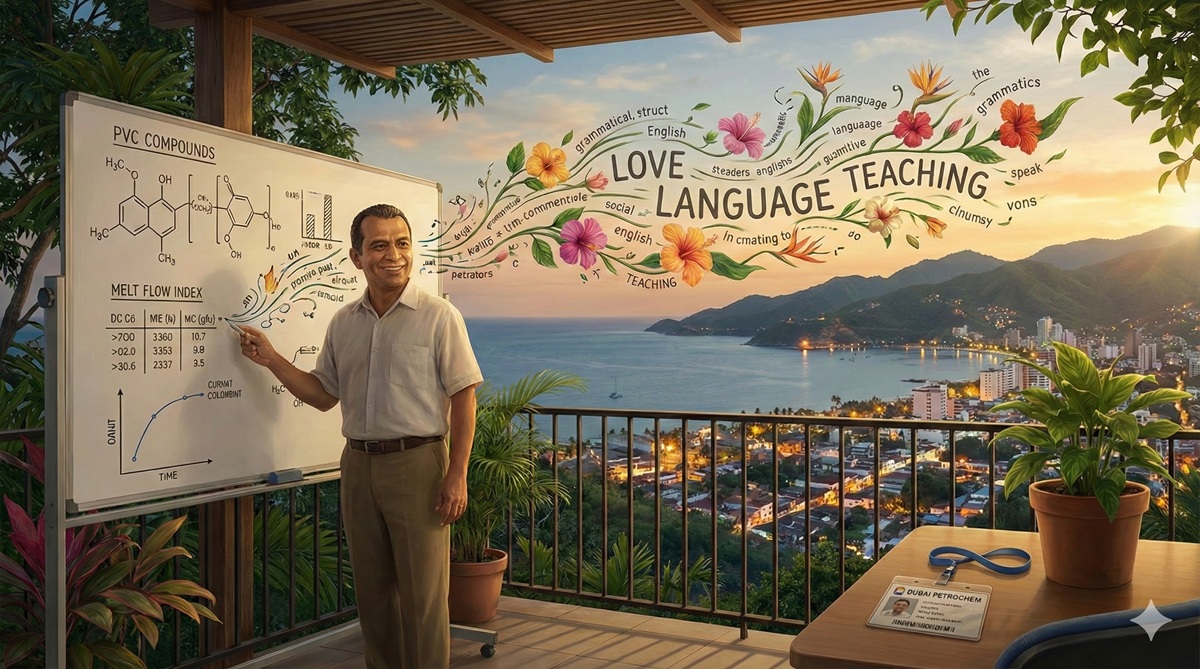
The ledger pages of my old life were filled with numbers that spoke of tensile strength, melt flow indexes, and bulk densities. For years, my world was the air-conditioned hustle of Dubai, a city of shimmering glass and ambition, where I worked for my family’s business supplying chemical raw materials. I could talk for hours about the plasticizing properties of DINP in flexible PVC compounds or the impact resistance of polypropylene copolymer. It was a world of tangible things, of granules and pellets shipped in colossal white sacks, their value measured in metric tons and profit margins. It was a good life, a comfortable life, but one that existed in a climate-controlled bubble, devoid of the messy, unpredictable humidity of human growth.
The shift did not begin with a grand epiphany, but with a quiet, persistent voice that belonged to a woman in Santa Marta, Colombia. We met not in person, but in the digital ether, and our connection quickly became the most real thing in my life. Love has a gravity that can warp the trajectory of a life, pulling it from its calculated orbit. To be with her, I had to travel 13,000 kilometers, from the arid, gilded coast of the UAE to the lush, tropical foothills of the Sierra Nevada. I was trading a known, stable identity—the chemical materials provider—for the terrifying and exhilarating unknown.
The initial feelings were a cocktail of thrilling anticipation and profound disorientation. Leaving the family business felt like cutting a tether. There was a deep-seated fear of failure, of being an imposter. Who was I without the business card that so neatly defined me? In Dubai, I was someone. In Santa Marta, I was just another foreigner, my identity as fluid and unformed as the hot Caribbean air. The first few weeks were a lesson in humility. I fumbled with Spanish in grocery stores, missed the structured urgency of the business world, and felt a loneliness that was amplified by the fact that I was there for the one person who made it all worthwhile. It was a paradox: I had never been happier in my personal life, yet I had never felt more professionally adrift.
Necessity, as much as a burgeoning desire, led me to teaching. My English was my most readily marketable skill. I took a TEFL, CELTA, TESOL courses online, the grammar rules feeling sterile and theoretical compared to the dynamic chemistry data sheets I was used to. My first job was at a small language institute, a world away from the corporate towers of Dubai. The night before my first class, a group of twenty teenagers, I was gripped by fear so visceral it was nauseating. This wasn’t a negotiation with a procurement manager where the worst outcome was a lost contract. This was standing in front of human beings, tasked not with transferring information, but with sparking understanding. The stakes fell infinitely higher.
The night before my first class, a group of twenty teenagers, I was gripped by fear so visceral it was nauseating. This wasn’t a negotiation with a procurement manager where the worst outcome was a lost contract. This was standing in front of human beings, tasked not with transferring information, but with sparking understanding. The stakes fell infinitely higher.
I remember walking into that classroom, the faint, chemical scent of dry-erase markers hanging in the air, the sea breeze drifting through the open windows. The students’ eyes were on me—curious, bored, skeptical. My palms were damp. I uncapped a blue marker and wrote my name on the pristine whiteboard, the squeak of the tip the only sound breaking the silence. My handwriting looked strangely foreign, a stark declaration of my new identity. I took a deep breath, turned to them, and began.
«Good morning. My name is…»
And at that moment, something shifted. The fear didn’t vanish, but it was eclipsed by a new, overwhelming sensation: connection. I was no longer just a former salesman or a lovesick immigrant. I was a conductor, however clumsy, of a shared endeavor. We stumbled through introductions together. We laughed when I mispronounced a Spanish name and when they butchered an English vowel. The transaction was no longer about goods and currency, but about confidence and comprehension. In that first class, I didn’t teach them much grammar, but I hope I gave them a glimpse that English wasn’t a monster to be feared, but a tool to be played with. The feeling that washed over me afterward was a pure, undiluted joy I had never found in closing a six-figure deal. It was the joy of usefulness, of human resonance.
That feeling only deepened and evolved as the months turned into years. Watching a student’s mind expand is nothing like watching a quarterly sales report trend upward. It is a slower, more organic, and far more beautiful process. It is exactly like tending to a garden. You plant the seed of a complex concept, water it with patience and repetition, and provide the sunlight of encouragement. For weeks, sometimes months, there seems to be nothing. Then, one day, a reserved student who struggled with academic syntax raises his hand and deftly employs a conditional clause to debate a point. A green shoot breaking through the soil.
I have watched these seeds become sturdy saplings. I’ve seen Ana, a first-year biology major, transition from stumbling through simple greetings to confidently presenting her research on coral reef degradation to a visiting professor. I’ve seen Mateo, who was initially paralyzed by the fear of making mistakes, finally find his voice, leading a spirited classroom debate on Gabriel García Márquez with passion and imperfect, but wholly effective, fluency. These are not metrics of success; they are milestones of a human spirit expanding its territory. The pride I feel is not personal, possessive pride, but a wondrous, shared pride. I was merely the gardener who provided the water; they did the hard, brave work of growing towards the sun.
The shift in my work, my residence, and my very soul has been the most profound education of my life. I left a world of defined quantities for one of unquantifiable qualities. I traded the certainties of polymer chains for the beautiful uncertainties of the human mind. The man who once worried about the shelf life of plasticizers now worries about the lasting impact of his words on a young person’s confidence.
And the reason for it all, the love that drew me across the world, is now my wife. We sit in our garden in the evenings, the lights of Santa Marta twinkling below like a terrestrial constellation, and I tell her about my day. I tell her about the student who finally understood the present perfect, and she smiles, knowing that she was the one who led me to this purpose. The 13,000-kilometer journey wasn’t just a trip to find my heart; it was a pilgrimage to find my true work. I went from selling the materials that shape objects to participating in the far more sacred task of helping to shape potential. And in that fertile, humid soil of a new country and a new vocation, I found not just a life, but a self I never knew I had the capacity to become.
With love Talal AlMoeen
Recommended125 dieron "Me gusta"Publicado en Docentes innovadores, Humanidades, Idiomas
















Comentarios
A heartfelt story about how love can change the course of a life and lead us to discover a greater purpose than we ever imagined. It inspires us to dare to start over.
I believe the text is deeply moving and authentic because it shows a real transformation, not only in career but in identity. What impacted me the most was how he described the contrast between a life measured by profits and numbers and a life measured by human growth and connection. The way he expressed his fear before his first class made the story feel honest and relatable. It reminds us that change is never easy, even when it is driven by love. In the end, I think the message is powerful: true fulfillment does not always come from stability or financial success, but from finding purpose and making a difference in the lives of others
I think the text is very sincere and inspiring because it shows how someone left a stable life for love and found a deeper purpose as a teacher. I liked the contrast between his old job focused on business and money and his new life focused on helping people grow. You can feel his fear at the beginning, which makes the story more real. In the end, the message is clear: sometimes taking a risk and leaving your comfort zone can help you discover a better and more meaningful version of yourself.
Your story is incredible. You show a drastic decision that has brought a big change to your life. Many people do not dare to make these kinds of decisions. I am happy that you have been able to find a place where you can develop your vocation, and it is clear that you teach with great patience and a purpose strong.
I find this story fascinating, Professor. At the same time, I see it as a way of saying that sometimes we must take a leap of faith in life to experience new and different things, no matter how afraid we might be. Because it is different, you show us that success isn’t just about money; instead, success is something where one feels fulfilled and complete much happier even if that doesn’t mean it is simple or easy. We simply have to enjoy it all, just like when learning a language: sometimes feeling foolish due to a lack of fluency holds us back, but it is always better to laugh at our mistakes and have the right attitude to keep improving. After all, today’s mistakes build the success of tomorrow.
Leaving behind the certainty of numbers and formulas to venture into the unpredictable is a powerful journey. Your story demonstrates that love and dedication transform fear into confidence, that our «almost perfect» life can be even better if we dare to change.
For me, it’s a call to take risks and pursue those desires in my heart that remain unfulfilled because of the fear that overwhelms me to leave the familiar and take a chance on an uncertain future. I hope to bring the same devotion to everything I do as you do.
Thank you for sharing your story with us.
The garden metaphor beautifully reflects what teaching truly means: to plant, to wait, and to nurture